2026 Canadian buyer's guide
Commercial HVAC Field Service Management Software Comparison
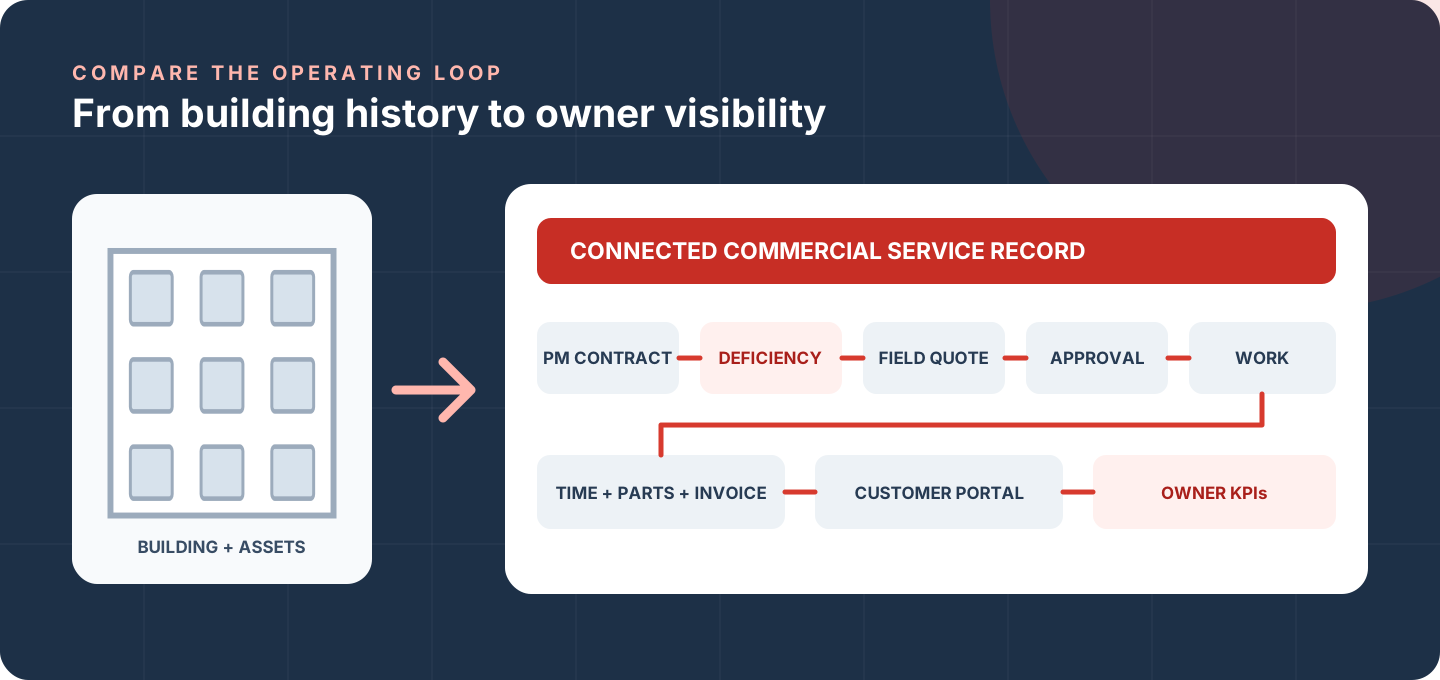
The useful question is not “Which field service system has dispatch and invoicing?” Most credible systems do. The useful question is whether the platform can model your complete commercial HVAC service loop without spreadsheets, duplicate entry, and office-side stitching.
Executive summary
- Start with operating fit, not feature count. A small office team cannot afford to reconnect field notes, equipment records, quotes, approvals, return visits, parts, and invoices by hand.
- GamePlanPro belongs on the commercial HVAC-specific shortlist. Its centre of gravity is independent Canadian commercial service, PM, same-visit deficiency quoting, asset history, customer transparency, and owner KPIs.
- BuildOps, ServiceTrade, Simpro, and Fieldpoint are the closest general commercial-contractor comparisons. Each has a different balance of project breadth, asset maintenance, service agreements, inventory, ERP integration, and implementation weight.
- Add FIELDBOSS when Microsoft is strategic. Add Jonas when construction accounting, payroll, job costing, and WIP drive the decision. Consider ServiceTitan when residential/commercial breadth, call-centre process, marketing, payments, and multi-branch scale matter.
- Run one identical commercial scenario in every demo. That exposes workflow gaps faster than a vendor-led feature tour.
What the software must connect
A commercial HVAC contractor is maintaining a durable operating record for buildings and equipment, not simply dispatching isolated jobs. Your short list should preserve context through the entire revenue and service cycle:
For commercial HVAC companies with 15–50 technicians, every extra handoff lands on a small number of dispatchers, service coordinators, estimators, and accounting people. Workflow gaps become capacity constraints quickly.
Commercial HVAC FSM platform comparison
This directional assessment is based on publicly available vendor information and Ucora’s experience, not standardized hands-on testing. It considers commercial HVAC workflow fit, configurability, implementation complexity, and scalability. Labels such as “Very high” and “High” indicate apparent fit, not equivalent features, integrations, or Canadian configuration.
| Platform | Best-fit operating model | Directional assessment | Primary trade-off to test |
|---|---|---|---|
| GamePlanPro | Canadian commercial HVAC service focus with asset-heavy PM scheduling, tight agreement management, same-visit quoting, customer portal use, and quote pull-through. | Very high | Integration specifics, Enterprise customization governance, and real-site connectivity behaviour. |
| BuildOps | Commercial mechanical, HVAC, electrical, and plumbing contractors running service plus projects, assets, closeout, inventory, and ERP sync. | Very high | A broad commercial-contractor rollout may require more process change and implementation effort. |
| ServiceTrade | Commercial service contractors focused on agreements, deficiencies, proposals, customer communication, and service transparency. | High | Check for HVAC-only workflow depth and Canadian configuration for your specific operating model. |
| Simpro | Asset-heavy service businesses needing maintenance scheduling, recurring invoicing, inventory, projects, forms, and mobile execution. | High | Configuration, add-ons, rollout effort, and how service and project complexity affect daily usability. |
| Fieldpoint | Larger or integration-heavy service firms needing configurability, ERP integration, projects, job costing, contracts, and mobile workflows. | High | Enterprise depth can add implementation complexity for commercial HVAC companies with 15–50 technicians. |
| FIELDBOSS | HVAC or elevator contractors that want Microsoft Dynamics 365 or Business Central as the operating backbone. | High | Whether the Microsoft architecture is strategic enough to justify its scope and implementation weight. |
| Jonas | Mechanical contractors prioritizing contractor ERP, accounting, payroll, job costing, WIP, procurement, PMAs, service, and projects. | Medium-high | Field deficiency quoting, customer transparency, and day-to-day commercial service workflow. |
| ServiceTitan | Larger mixed residential/commercial or multi-trade contractors seeking broad call-centre, marketing, service agreement, project, payment, and platform capabilities. | Medium-high to high | Commercial asset depth, Canadian fit, implementation scope, and whether residential-first capabilities add value. |
| FieldEdge | QuickBooks-centred HVAC, plumbing, and electrical contractors needing light FSM and dispatch capabilities. | Medium | Check for commercial asset depth, multi-role jobs, portal visibility, equipment history, reporting, customization, and Canadian localization. |
| Jobber | Small to mid-sized home-service and light-commercial contractors prioritizing simplicity, scheduling, quotes, invoices, payments, and a client hub. | Low-medium to medium | Check for complex building, equipment, PM agreements, commercial-grade multi-role workflow depth. |
| Praxedo | Companies seeking a field-execution layer with routing, mobile work orders, offline mode, compliance forms, and technician activity tracking. | Medium | Whether it replaces or complements the commercial HVAC back office, CRM, accounting, and customer portal stack. |
GamePlanPro capability profile
GamePlanPro is positioned by Ucora as Canadian-built software for independent commercial HVAC service companies. Its strongest case is the combination of a commercial data model, field quoting, PM execution, customer transparency, rate governance, asset history, and owner visibility—not a single isolated feature.
Commercial HVAC data model
Connected records cover customers, property management firms, managers, contacts, buildings, roof sections, equipment, contracts, work orders, quotes, proposals, invoices, documents, time, materials, history, scheduling, and KPIs.
Same-visit deficiency quoting
Technicians can quote from a work order using live account, equipment, service-history, and pricing context. The workflow includes revisions, clauses, urgency, follow-up, approvals, reject reasons, proposal generation, and conversion to work.
Commercial customer portal
Ucora states that customers can review and approve deficiency quotations and maintenance proposals, see recent work, buildings and equipment, request work or quotations, and access AI-generated building summaries.
PM contracts and rate governance
Maintenance contracts can include equipment-specific profiles, inspections, filters, belts, and maintenance runs. Rate templates, bulk updates, locked exceptions, PM profile fees, and change history support pricing discipline.
Dispatch, roles, and field context
Work can be scheduled, assigned without a fixed time, or posted to a Work Pool. Role statuses support multi-person execution, while equipment records retain service, quotation, maintenance, model, serial, refrigerant, voltage, phase, filter, and belt context.
Management KPIs and AI
Ucora describes KPIs for quote backlog and follow-up, WIP, complete-not-invoiced work, margin, callbacks, billable hours, close rate, and productivity. GPP-AI supports drafts and summaries and uses human review for customer-facing AI output.
Plans and customization
According to Ucora, all modules are included in both the Flex and Enterprise plans. Enterprise starts with Flex and adds unlimited system customizations, including the possibility of a customer-specific code fork. This is an uncommon option among the products reviewed.
Reliability, speed, and connectivity
Ucora represents GamePlanPro as a mature, highly reliable, responsive field service platform with 25 years of track record. These are vendor claims and should be observed in a production-like environment.
GamePlanPro is a connected system rather than an offline-first platform. It is designed for speed and reliability, and submissions are retained until connectivity is restored.
Operational requirements checklist
Require each shortlisted vendor to show—not merely say—how its software handles these commercial mechanical service requirements.
Reliability and data retention
Work orders, reports, photos, documents, time, tasks, quotes, and status changes must save predictably and load quickly under realistic volume.
Equipment history and search
Demand equipment-level history, asset-specific quotes, model and serial data, QR tags, filters, belts, refrigerant, photos, open work, and fast search across large sites.
Multi-role work orders
Test diagnostic, quoting, return repair, controls, refrigeration, sheet metal, office review, and billing roles on multi-person and multi-day work.
PM contracts and rates
Verify equipment-specific tasks, visit frequencies, seasonal workload balancing, contract coverage, renewals, labour rates, exceptions, material markup, and annual increases.
Dispatch and field usability
Test calendar and unscheduled work, workload, routing, skills and certifications, time off, work pools, status signals, and large equipment lists on the actual phones and tablets your team carries.
Time, parts, billing, and accounting
Run time corrections, payroll visibility, supplier documents, material reconciliation, invoice credits, Canadian taxes, and the complete accounting export or integration path.
Customer and property-manager portal
Verify permissions, multi-building access, equipment lists, recent work, open deficiencies, quotation and maintenance-proposal approvals, and new request intake.
Owner-level reporting
Ask the system to expose old unsent quotes, sent-unapproved quotes, follow-up, approved-unscheduled work, WIP, incomplete work, complete-not-invoiced work, margin, callbacks, billable hours, and productivity without spreadsheets.
Read more: independent verification checklist before signing
- Portal: confirm permissions for property managers, requests, test quote approvals and building equipment visibility.
- Reliability and speed: observe real work-order, quote, equipment, attachment, portal, reporting, and mobile submissions under realistic data volume and poor connectivity.
- Accounting: test invoices, credits, taxes, payroll, time, parts, and reconciliation end to end with your actual accounting product and chart of accounts.
- Customization: define scope, ownership, sandbox testing, release notes, regression testing, support response, documentation, and upgrades in the contract.
- AI: confirm what is generated, where the source context comes from, who can edit prompts, who reviews customer-facing output, and how errors are corrected.
- Migration: test import order, duplicates, IDs, contacts, buildings, equipment, service history, PM contracts, open work, open quotes, documents, and portal access.
Build the shortlist around your centre of gravity
Independent commercial HVAC service
Start with: GamePlanPro, BuildOps, ServiceTrade, Simpro, and Fieldpoint. Add FIELDBOSS if Microsoft is strategic. This is the closest set for asset-heavy PM, deficiency quoting, approvals, field history, rates, and owner KPIs.
Service plus significant projects or retrofit
Start with: GamePlanPro, BuildOps, Simpro, Fieldpoint, FIELDBOSS, ServiceTitan, and Jonas. Weight project costing, procurement, inventory, closeout, construction accounting, and the handoff back to service.
Mechanical construction contractor
Start with: Jonas, FIELDBOSS, BuildOps, Fieldpoint, Simpro, and ServiceTitan. ERP, payroll, WIP, procurement, job costing, and project controls may matter more than same-visit service quoting.
Residential-first or light commercial
Start with: Jobber, FieldEdge, Housecall Pro, Service Fusion, and ServiceTitan. Simplicity, call booking, dispatch volume, quoting, invoicing, payments, reviews, and QuickBooks may outweigh deep asset and PM logic.
Bottom line: GamePlanPro should be high on the shortlist when your company is an independent Canadian commercial HVAC service operator with meaningful PM revenue, equipment-heavy customer relationships, deficiency quote opportunities, and a small office team that needs the field-to-invoice loop to stay connected. If construction ERP, payroll, WIP, procurement, Microsoft standardization, or residential volume is the dominant problem, another platform may be the more natural centre of gravity.
Research basis and source notes
This article adapts the standalone research study, GamePlanPro and Commercial HVAC Field Service Management Platforms in Canada, prepared in June 2026. Public vendor pages informed the market-positioning summaries; Ucora-provided materials supplied the detailed GamePlanPro profile. The directional assessment considers commercial HVAC workflow fit, configurability, implementation complexity, and scalability. Ucora publishes this guide and develops GamePlanPro. Vendor marketing pages are not neutral technical specifications, product details can change, and buyers should verify material requirements through demonstrations, written proposals, contracts, service-level commitments, and customer references.
Read the public sources referenced in the research note
- Ucora: Why GamePlanPro works for commercial HVAC service
- Ucora: GamePlanPro commercial field service software
- Ucora: commercial HVAC case study
- BuildOps official website
- ServiceTrade commercial HVAC page
- Simpro HVAC software page
- Fieldpoint official website
- FIELDBOSS official website
- Jonas service management page
- ServiceTitan service agreement page
- FieldEdge field service software page
- Jobber HVAC software page
- Praxedo HVAC-R page
- Service Fusion HVAC page
- Dataforma HVAC page